Flamingo Plaster Sculpture Black Ceramic Round Base-Leg Lift Like

Flamingo Plaster Sculpture Black Ceramic Round Base-Leg Lift Like

Flamingo Plaster Sculpture Black Ceramic Round Base-Standing Statue

Flamingo Plaster Sculpture Black Ceramic Round Base-Standing Statue

French geometric design marble lover statue ornaments
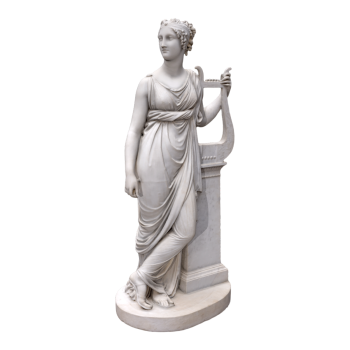
French geometric design marble lover statue ornaments

Marble statue of the Cleveland Museum of Art The Muse of Poetry

Marble statue of the Cleveland Museum of Art The Muse of Poetry

The Poetic Muse in Ancient Greek Mythology She is one of the nine Muses who inspired her creation. She holds a lyre and has a double snake-wound staff. The statue was carved out of marble by Italian sculptor Antonio Canova in 1816. It is one of nine muse statues designed by Canova for Tsar Alexander I of Russia. The statues were originally intended to be placed in the Hermitage Museum in St. Petersburg, but they were scattered to different places due to the sudden death of the Tsar. The Poetic Muse was eventually acquired by the Cleveland Museum of Art in 1968. It is one of the museum's most important collections.
A plaster image of The Thinker at the Rodin Gallery in Paris

A plaster image of The Thinker at the Rodin Gallery in Paris

The Thinker is a sculpture created by French sculptor Auguste Rodin. The plaster model was made in 1880 with a height of 68.5cm. Now in the collection of the Rodin Gallery in Paris., It depicts a naked male sitting on a rock, showing concern and sympathy for the fate of mankind in a thoughtful gesture. This work was originally designed for the central part of Rodin's other giant sculpture, The Gates of Hell, which was later enlarged by Rodin and became a famous work on its own. The Thinker is considered one of Rodin's masterpieces and one of the most influential sculptures in the history of Western art.
The Abduction of Prosopina in Marble at the Bogise Gallery in Rome

The Abduction of Prosopina in Marble at the Bogise Gallery in Rome

The Abduction of Proserpina is a large group of Baroque marble sculptures by Gian Lorenzo Benigni. The sculpture depicts a Roman mythology in which Pruto, the god of the underworld, captures and takes Prosopina. Pruto exalts Proserpina, while Serborus symbolizes the border of the underworld into which Pruto brought Proserpina. The sculpture is made of Carrara marble and was originally placed on an already destroyed pedestal with a poem by Barberini Maffeo. The sculpture is now located in the Bogise Gallery in Rome.
Rhinoceros Orsay Museum Collection

Rhinoceros Orsay Museum Collection

This is a cast-iron sculpture by Henri Alfred Jacquemart, made in 1878 for the Universal Exhibition in Paris, now located outside the Musée d'Orsay. The sculpture is very realistic and shows the image and power of an Indian rhinoceros.
Bust of Sir Robert Bruce Cotton

Bust of Sir Robert Bruce Cotton

Sir Robert Bruce Cotton (Sir Robert Bruce Cotton,1571-1631) was a British politician, ancient book collector and scholar. He founded the Cotton Library (Cottonian Library) and collected a large number of precious manuscripts and Documents have an important influence on British history and culture.
Ramses II Granite Head British Museum Collection
Ramses II Granite Head British Museum Collection

This statue depicts the 19th Dynasty Pharaoh Ramses II wearing a holy serpent crown and a Nimes turban. The statue was damaged by the time it was found, with the limbs and lower half missing. It is one of a pair of statues of Ramses originally located on the flank of the gate of the Temple of Lamesim, and the head of the other statue is still at the gate of the Temple of Lamesim. The statue was transported from Egypt to England in 1816 by the Italian explorer Giovanni Berzoni and acquired by the British Museum in 1821. It is now one of the representative artifacts of the British Museum, displayed in Hall 4.
Italian Abstract Interior Ornaments Kneeling Bucks Bronze Statues

Italian Abstract Interior Ornaments Kneeling Bucks Bronze Statues

Italian abstract interior decoration stag bronze statue

Italian abstract interior decoration stag bronze statue

Italian Art Deco Silver Deer Statue

Italian Art Deco Silver Deer Statue

Italian Art Deco Obsidian Deer Statue

Italian Art Deco Obsidian Deer Statue

Italian Art Deco Bronze Art Deer Statue

Italian Art Deco Bronze Art Deer Statue

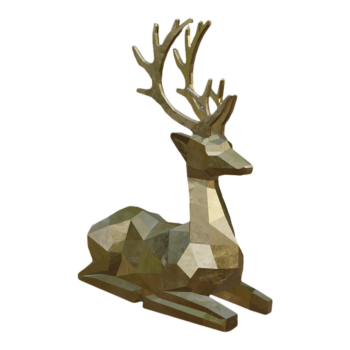
Italian Art Deco Walnut Art Deer Statue
Italian Art Deco Walnut Art Deer Statue

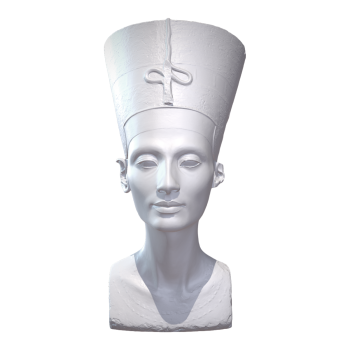
Plaster statue of Nefertiti (Queen of Pharaoh Akhenaten of Egypt)

Plaster statue of Nefertiti (Queen of Pharaoh Akhenaten of Egypt)

Bronze statue of LaOCon and his sons

Bronze statue of LaOCon and his sons

This is an ancient Greek sculpture depicting the tragic scene of Troy temple priest Laocon and his two sons in the midst of being entangled by poisonous snakes.
Amitabha Statues

Amitabha Statues

Guofeng marble monk sculpture incense burner

Guofeng marble monk sculpture incense burner

Bronze statue of Napoleon the Great
Bronze statue of Napoleon the Great

Napoleon Bonaparte (August 15, 1769-May 5, 1821), that is, Napoleon I, was born in Corsica, a great French military strategist and politician in the 19th century, and the founder of the first French Empire. He was the first ruler of the First Republic of France (1799-1804) and the First Emperor of France (1804-1815).
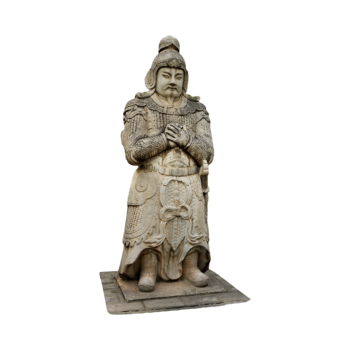
Stone Statue of Shinto in Ming Xiaoling Mausoleum

Stone Statue of Shinto in Ming Xiaoling Mausoleum

Shinto is the way to the dead. Shinto is also called the way of heaven and Sima way, and it is said in the Book of changes that "the grand view is on the top, the smooth view is on the top, the positive view is on the world. The view is on the back, but not recommended, there is a water on the bottom, and the lower view is transformed. The Shinto of the sky is observed, but the sage is taught by Shinto, and the world is subjued". Since the Han Dynasty, Shinto has also referred to "opening the way in front of the tomb and building stone pillars as a mark".